
Tuckpointing & Repointing in Chesapeake, VA
Mortar joints take the weather so your brick doesn’t have to. Once they crack, recede or start to crumble, rain has a way into the wall. CMC Chesapeake Masonry repoints failing mortar on brick walls, chimneys, steps, foundations and garden walls across Chesapeake: the old mortar is cut out to sound material and replaced with a mix chosen for your brick.
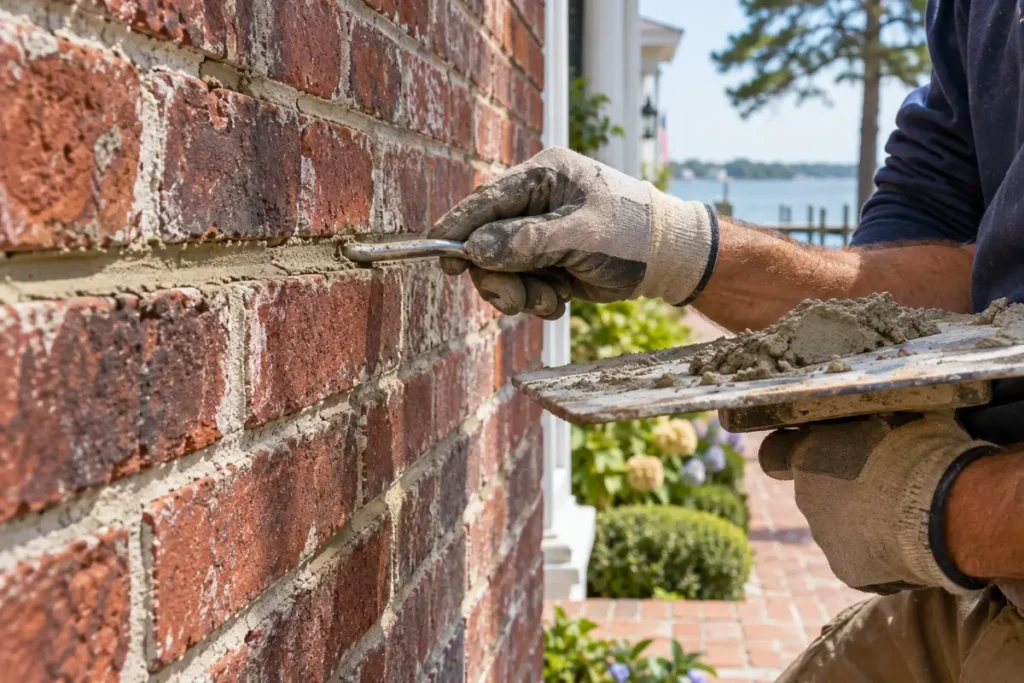
Tuckpointing vs. Repointing: What the Terms Mean
Repointing is the repair itself: removing deteriorated mortar from the joints to a sound depth and filling them with new mortar. It is what most people need when they search for tuckpointing or brick mortar repair.
Tuckpointing originally meant something more specific. As the National Park Service’s guidance on repointing explains, traditional tuckpointing finished a joint with a narrow, contrasting line of mortar to give brickwork a crisp, decorative look. Some older buildings still have it.
Over time the words blurred. Homeowners and contractors now say tuckpointing, tuck and point and repointing almost interchangeably, and all of them usually mean replacing worn mortar. This page covers that everyday repair. If your home does have true tuck pointed brickwork with a raised decorative joint, that finish needs to be matched, not swapped for an ordinary flat joint.
Signs Your Mortar Joints Are Failing
Mortar wears out gradually, and the early signs are easy to miss from the driveway. Up close, look for:
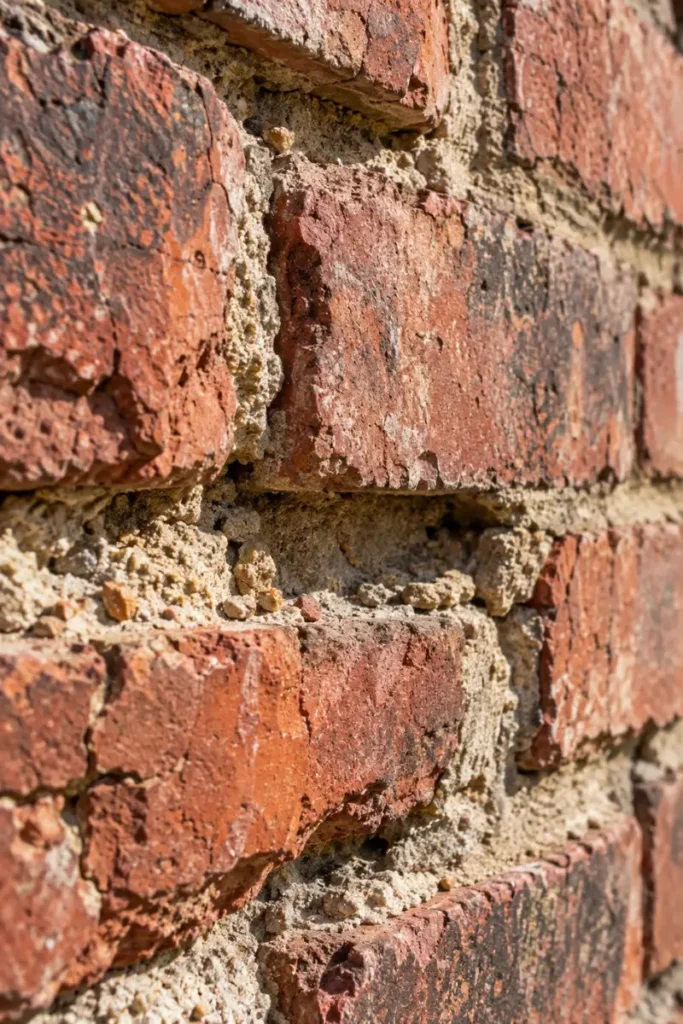
- Recessed joints, where the mortar has eroded back behind the face of the brick.
- Crumbling or sandy mortar that comes away when you run a finger or a key along it.
- Cracks along the joints, or hairline gaps where the mortar has pulled away from the edge of the brick.
- Loose bricks, especially on steps, wall caps and the top of a chimney.
- Signs inside: damp patches, stains or peeling paint on interior walls next to an exterior wall or chimney.
National Park Service maintenance guidance recommends checking masonry periodically and again after major storms, which is when wind driven rain finds weak joints. If the bricks themselves are cracked or flaking, rather than just the mortar between them, that calls for brick and masonry repair.
What Repointing Actually Fixes on Your Home
Repointing is not cosmetic touch up. Done properly, it restores the part of the wall that is designed to protect everything else.
It closes the main path for water
Brick walls absorb some rain and dry out again. Open joints change that. The Brick Industry Association’s guidance on water penetration treats the joints as one of the main routes for water into a wall, especially when wind drives rain against it. Once water gets in through failing mortar, it sets off a chain of problems: damp interior walls, white efflorescence deposits as dissolved salts migrate to the surface, and spalling when wet brick goes through freezing or salt crystallization. New, well compacted joints shut that route.
It keeps the mortar as the sacrificial element
In a healthy wall, the mortar is meant to be the weaker, more permeable part. National Park Service Preservation Brief 2 explains why: moisture and stress should move through the joints, which can be renewed, instead of through the brick, which is much harder to replace. Repointing renews that sacrificial layer before the brick starts taking the damage.
It restores weather tightness and appearance
Joints that are filled solidly and tooled to a compact profile shed water better than eroded ones; BIA guidance on workmanship links tooled, compacted joints to better water resistance. The visual change is real too. Even, matched joints make old brickwork look cared for instead of tired.
What repointing does not fix
New mortar will not repair a brick that is already cracked or spalled; those units need replacing through brick and masonry repair. It will not stop structural movement either. Cracks that keep reopening or walls that bulge need their cause found first, and some need a structural engineer’s evaluation. And if a leak comes from failed flashing, repointing alone won’t stop it: chimney flashing is covered under chimney repair, and flashing and weep holes on brick clad walls under brick veneer repair.
Not sure which of these you’re dealing with? Call (757) 290-8274; an estimate is free.
Choosing and Matching Mortar
Mortar is not one product. The common types are designated N, S and O, and lime based mortars sit at the softer, more permeable end of the range. Type S is the stronger of the three; Type O is weaker and more flexible; Type N falls between. The Brick Industry Association’s guidance on mortar selection is clear that the right choice depends on the application, and that a stronger mortar is not automatically a better one.
A good repointing match covers four things:
- Color, which comes mostly from the sand and binder, not only pigment.
- Texture, set largely by the sand.
- Joint profile, the shape the joint is tooled to.
- Hardness and permeability, which matter most for how the wall performs.
Color changes as mortar cures, so matching is judged on samples that have been allowed to cure. Hardness is where repointing most often goes wrong. Mortar that is harder and less permeable than the brick pushes moisture and stress into the brick instead, and the result is often chipped or spalled brick edges next to joints that still look fine. Our guide to why mortar matching matters on older brick goes into more depth.
Lime rich mortar for older brick
Older brick is often softer than modern brick, and historic mortars were typically lime based. National Park Service guidance recommends that replacement mortar respect the strength and permeability of the original brick and mortar, which on many older homes points to a lime rich mix. That is a judgment made per wall, not a blanket rule: BIA guidance favors testing over prescribing one mortar type for every old building. When joint failure is widespread, or earlier repairs used the wrong mortar, the wall may need a broader plan through masonry restoration.
The Repointing Process, Step by Step
- Assessment. We look at which joints are failing, why, and what the existing mortar and joint profile are like.
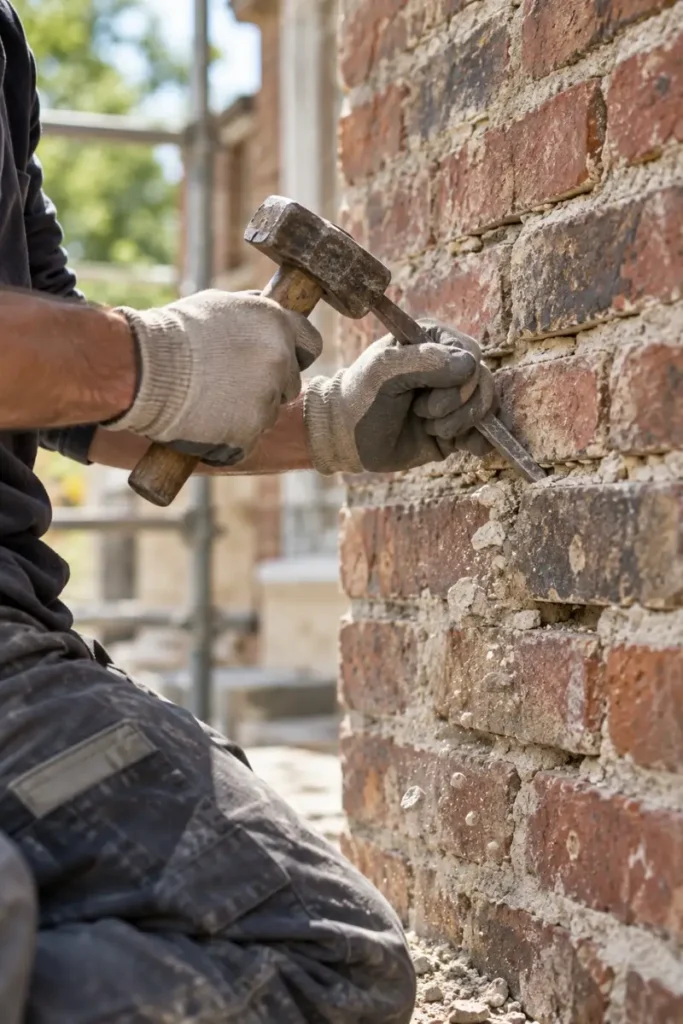
- Joint removal. Deteriorated mortar is cut out to a consistent depth. Preservation Brief 2 recommends a minimum of roughly two to two and a half times the joint’s width, and deeper where mortar is still loose, without damaging the edges of the brick.
- Cleaning out the joints. Dust and loose debris are cleared so the new mortar bonds to sound material.
- Mixing. The mortar is mixed to the selected formula, matched for color, texture and hardness.
- Filling. Joints are packed firmly; deep joints are filled in layers so each one can firm up before the next.
- Tooling. Each joint is tooled at the right moment to match the existing profile and compact the surface.
- Curing and finishing. The new mortar is protected while it cures, and mortar smears are cleaned from the brick face.
Weather limits for mortar work
Mortar needs reasonable conditions to cure. BIA’s Technical Note 1 on hot and cold weather construction says protective measures become relevant once temperatures fall below 40°F, and in hot weather above 100°F, or above 90°F with wind over 8 mph. Those are guidance thresholds rather than a single stop work rule, but they explain why repointing is scheduled around the forecast.
Moisture, Coastal Weather and Mortar Life
In Chesapeake, the forces that wear out mortar are mostly about water. Hurricanes and nor’easters drive rain sideways into walls, so the sides of a house that take the most wind driven rain often show joint wear first. On properties close to salt water, salts carried into the joints crystallize as they dry, and Preservation Brief 2 identifies that crystallization as a way porous mortar breaks down from within. Joints that stay wet also have more to lose on the nights when temperatures drop below freezing.
There is no honest single number for how long mortar lasts here. BIA’s maintenance guidance gives estimated repair intervals, but they depend on the mortar, the exposure and how the wall was detailed. The practical approach is to look at your joints periodically and after major storms, and repoint the areas that are eroding before the brick starts taking the damage. Our overview of how Chesapeake’s weather affects masonry covers the wider picture.
What Our Tuckpointing & Repointing Service Includes
Structures we repoint: brick walls, chimneys, steps, foundations and garden walls.
A typical repointing job includes: a free assessment and estimate, joint preparation to the right depth, mortar selection and matching, filling and tooling, and protection while the mortar cures.
Handled as separate items or through other services: replacing cracked or spalled bricks, rebuilding a chimney, repairing a crown or replacing flashing, and whole building plans for aging masonry. When those come up, they’re scoped and estimated on their own terms.
Related Services and Areas We Serve
Repointing often sits next to other work. If individual bricks, blocks or stones are damaged, our masonry and brick repair service replaces and matches them. When mortar failure is widespread on an older building or earlier repairs have caused damage, masonry restoration plans the work as a whole. Chimneys get their own attention through chimney repair, where repointing often goes together with crown and flashing work.
Chesapeake is our primary market. We also repoint brick in Portsmouth, where historic neighborhoods such as Olde Towne have older brick; in Norfolk, including the city’s historic districts; and in Newport News.
Tuckpointing FAQ
How often does brick need repointing?
There is no fixed schedule. It depends on the mortar, how exposed the wall is and how well it sheds water. BIA’s maintenance guidance offers estimated intervals, but treats them as conditional. Repoint when joints have eroded back from the brick face, crumble when touched or have opened up, and check exposed walls and chimneys after major storms.
Can you match my existing mortar color?
In most cases, a close match is possible. Color depends mainly on the sand and binder, and new mortar looks different wet than cured, so the match is judged on cured samples. On weathered walls, new joints can look slightly fresher at first.
Is tuckpointing the same as repointing?
In everyday use, yes: both mean replacing worn mortar. Strictly, tuckpointing is a decorative finishing technique, explained above under Tuckpointing vs. Repointing.
Can repointing be done in cold weather?
It can, with care. BIA guidance calls for protective measures once temperatures drop below 40°F, so cold weather repointing depends on the forecast and on protecting the new mortar while it cures. Very hot, windy days call for precautions too.
Ready to stop water getting in through the joints?
Call (757) 290-8274 or request your free tuckpointing estimate.