
Chimney Repair in Chesapeake, VA
A chimney is the most exposed piece of masonry on a house. It stands above the roof line, takes wind driven rain on every side and has a flat top that has to shed water for decades. When it starts to fail, the first sign is often a stain on a ceiling or water in the firebox. CMC Chesapeake Masonry repairs masonry chimneys across Chesapeake: cracked crowns, worn mortar, spalled brick, flashing, liners and partial or full rebuilds.
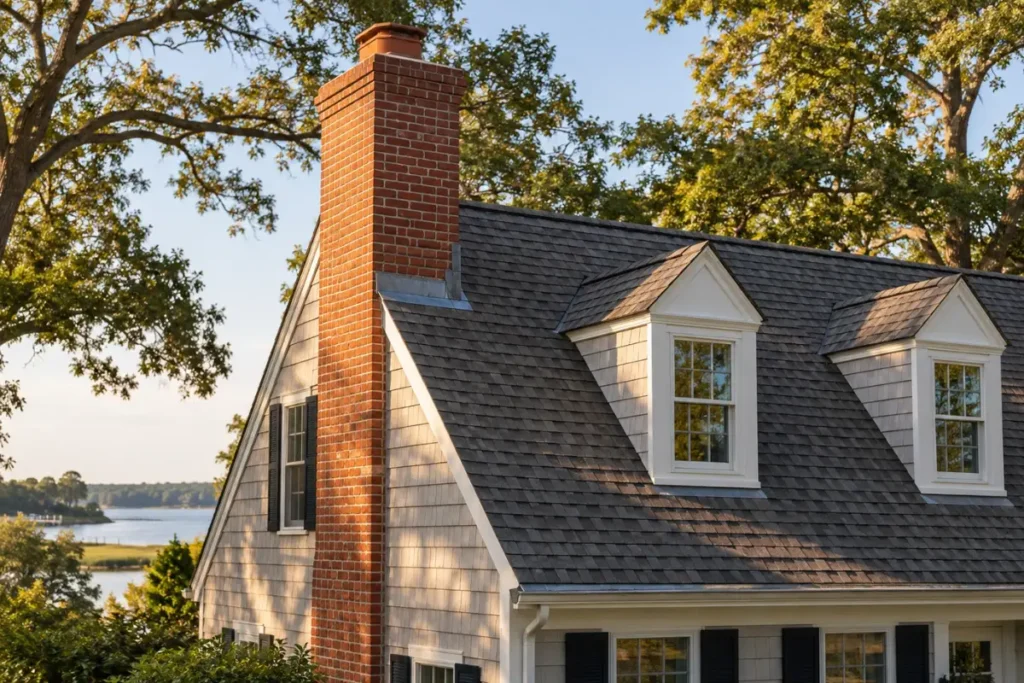
How a Masonry Chimney Is Built
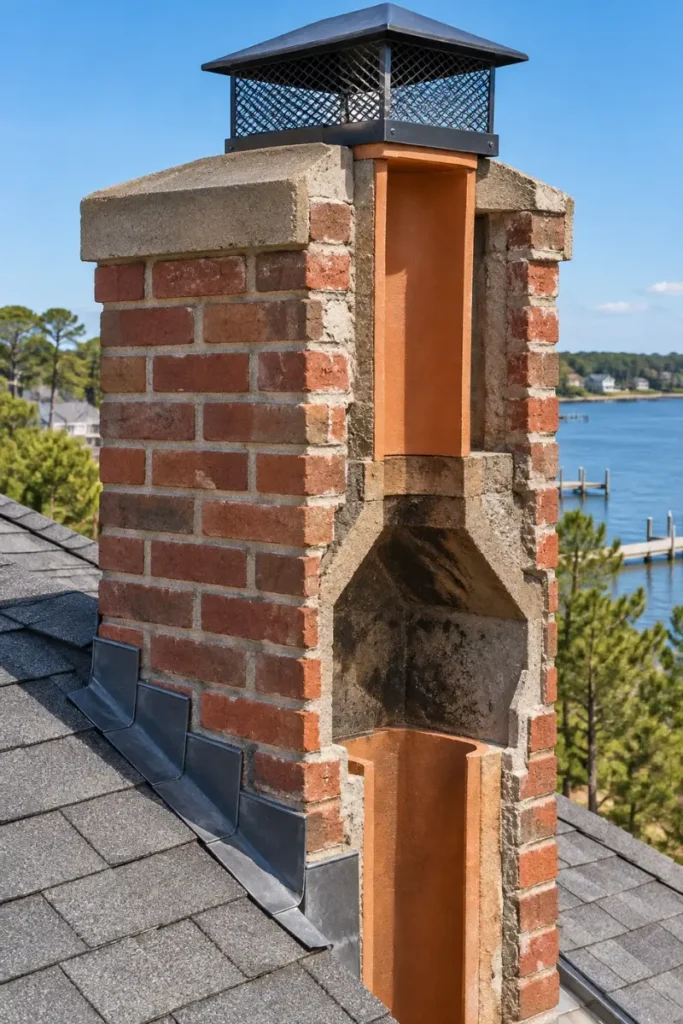
Knowing the parts makes it easier to understand what’s damaged and who fixes it. From the top down:
- Crown. The masonry slab that covers the top of the chimney around the flue. It is the chimney’s roof.
- Cap. A separate, removable fitting, usually metal, that sits over the flue opening to keep out rain and animals.
- Flue and liner. The passage that carries smoke and gases up and out. The liner lines that passage.
- Stack. The brick or stone body of the chimney, mostly visible above the roof.
- Flashing. Metal that seals the joint where the chimney passes through the roof.
- Smoke chamber. The transition above the fireplace that funnels smoke into the flue.
- Firebox. The fireplace opening where the fire burns.
The crown, stack, mortar joints and firebox brick are masonry work, done by a chimney mason. Flashing sits where masonry meets roofing. Sweeping the flue and removing soot and creosote is chimney sweep work, which is a separate trade. We work on liners as well as the masonry around them.
Common Chimney Damage and Warning Signs
From outside, look for:
- A cracked or crumbling crown, visible from the roof or with binoculars
- Missing or recessed mortar in the stack’s joints
- Spalled brick, flaking or popping off, often near the top
- A leaning stack, or a chimney pulling away from the house
- White efflorescence or dark staining running down the brick
- Loose or lifted flashing where the chimney meets the roof
Inside, the signs are usually water: damp or stained ceilings and walls near the chimney, water or rust in the firebox, and a musty smell from the fireplace after rain.
Hampton Roads storms make these worth checking after hurricanes and nor’easters, which the National Weather Service in Wakefield notes bring strong wind and heavy rain to the region. A leaning stack, or one that has moved after a storm, should be evaluated before anyone climbs on it. Worn mortar on its own can often be handled by repointing.
Chimney Crown Repair: Cracks, Sealing and Rebuilding
Many chimney leaks start at the top. The crown is the single surface that keeps rain out of the whole chimney, and when it fails, water goes straight into the stack.
Chimney crown vs. chimney cap
The two are often confused, and people sometimes search for fireplace crown repair when they mean the chimney crown. The crown is the masonry top of the chimney, built around the flue. The cap is a separate fitting over the flue opening. A cap keeps rain out of the flue; a crown keeps rain out of the masonry. A chimney usually needs both, and a cap does not make up for a failed crown.
Why chimney crowns crack
The model code is a useful guide to what a crown needs. The 2021 International Residential Code, which Virginia’s current residential code is based on, calls for chimney crowns made of durable materials, sloped so water drains off, with a drip edge and a bond break between the crown and the flue (IRC Chapter 10, section R1003.9.1). Crowns that crack usually miss one or more of those features:
- Mortar wash tops. Many chimneys are finished with a thin layer of ordinary mortar troweled over the top course instead of a properly built crown. It is not durable enough to act as a roof and tends to crack early.
- No overhang or drip edge. Without a projecting edge, water runs off the crown straight down the face of the stack instead of dripping clear of it.
- No bond break. When the crown is locked tight to the flue, the two can’t move independently as they heat, cool and get wet, and the crown cracks around the flue.
- Flat or ponding tops that hold water instead of shedding it.
What water through a failed crown leads to
Water that gets past the crown soaks the stack from the top down. That drives the damage that shows up lower: eroded joints, spalled brick near the top of the chimney, efflorescence, rusted dampers and water in the firebox, and stains on ceilings and walls inside. Fixing the brick without fixing the crown means the water keeps coming.
Seal or rebuild?
The choice depends on the crown’s condition and design:
- Sealing can be a reasonable stopgap for fine surface cracks in a crown that is otherwise sound, properly sloped and well built.
- Rebuilding is the better answer when the crown is broken up, crumbling, cracked through, built as a thin mortar wash, flat, or missing a drip edge. Sealing those only delays the next leak.
A rebuilt crown should include the features above: a durable material, slope to drain, an overhang with a drip edge, and a bond break at the flue.
If you’re comparing options and budgets, our guide to what affects chimney repair cost explains how crown work is scoped.
Seeing a crack on top of your chimney? Call (757) 290-8274 and we’ll take a look.
Chimney Repointing and Rebuilding
Below the crown, most chimney masonry work is either repointing or rebuilding.
Repointing replaces eroded mortar in the stack’s joints. The method is the same as on any brick wall, with extra attention to exposure, since chimneys take weather on all four sides. The full process is described under tuckpointing and repointing.
Partial rebuilding takes the stack down to sound masonry, often a few courses below a deteriorated top section, and relays it. Full rebuilding above the roof line is needed when damage runs through most of the exposed stack, when it is leaning, or when bricks are loose throughout. Rebuilding masonry chimneys is governed by the chimney provisions of Virginia’s building codes; Virginia’s current statewide codes, the 2021 cycle, took effect January 18, 2024, according to the Virginia Department of Housing and Community Development. When a rebuild requires a permit, we handle it.
Matching matters on a chimney as much as on a wall. Replacement brick is selected for size, color and texture, and mortar is matched to the existing joints. Individual damaged bricks lower on a chimney can be replaced through brick and masonry repair.
Flashing and the Roof Connection
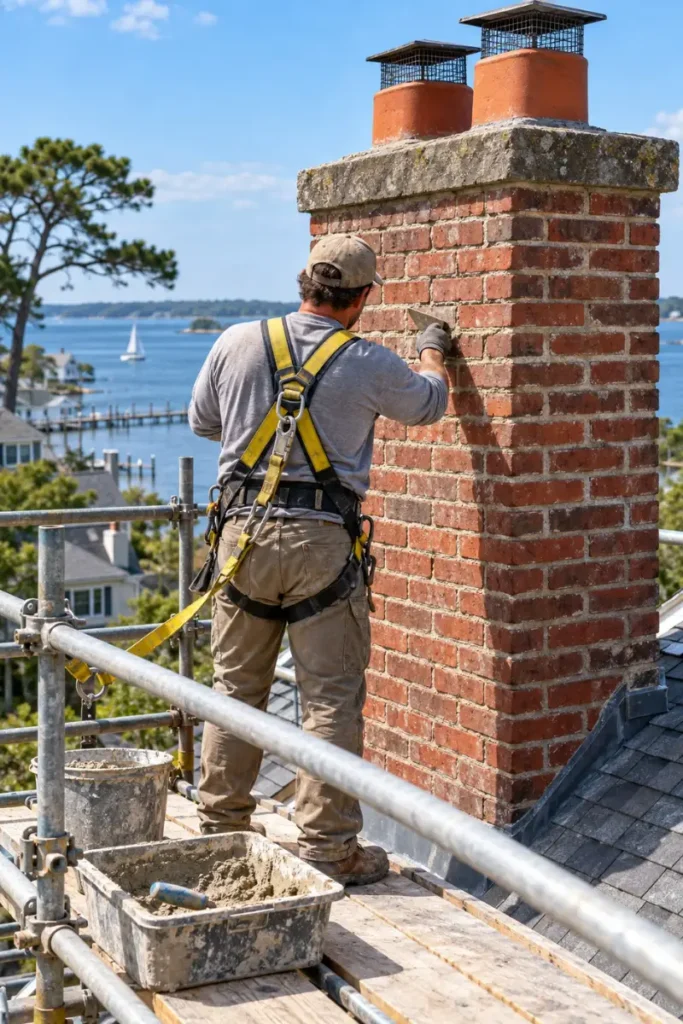
Where a chimney passes through the roof, flashing seals the gap. BIA’s brief on flashing chimneys describes the two layers: base or step flashing that runs under the roofing and up the side of the chimney, and counterflashing set into the mortar joints that laps down over it, so water is shed at every point.
Flashing fails when it is loose, lifted, rusted, or held on only with surface caulk; caulk is not a substitute for a proper flashing system. A leak at the roof line can come from the flashing, the crown or the masonry, so each is checked separately. We repair and replace chimney flashing, including resetting counterflashing into the mortar joints. The same water shedding principle applies to brick walls, where flashing and weep holes are covered under brick veneer repair.
Chimney Inspections: When to Get One
Chimney inspections follow NFPA 211, the National Fire Protection Association’s standard for chimneys, which describes three levels. The Chimney Safety Institute of America summarizes them this way:
- Level 1 covers the readily accessible parts of the chimney, inside and out.
- Level 2 goes further, including internal video scanning of the flue, and is used when something about the system has changed.
- Level 3 reaches concealed areas, sometimes requiring removal of parts of the structure, when a hazard is suspected that the first two levels can’t evaluate.
An inspection is worth having routinely if you use the fireplace, after a major storm that may have damaged the chimney, and before buying a home with one. A certified chimney inspector can tell you which level fits your situation. If the inspection finds masonry problems, such as a cracked crown, failing joints or a deteriorating stack, those are the repairs described on this page.
What Affects Chimney Repair Cost
We don’t publish chimney repair prices, because they depend on the chimney. The main factors are:
- The type and extent of damage: crown, mortar, brick or flashing, and how much of each
- Height and access: chimney height, roof pitch and how safely the top can be reached
- Rebuild extent: none, a partial rebuild or the full stack above the roof
- Materials: matching older brick and mortar
Our article on what affects chimney repair cost goes into each factor in more depth.
Related Services and Areas We Serve
Chimney repointing follows the same process as tuckpointing and repointing on brick walls. Damaged bricks elsewhere on the house are handled through masonry and brick repair, and older chimneys on historic homes may be part of a broader masonry restoration.
Chesapeake is our primary market. We also repair chimneys in Norfolk, Portsmouth, Virginia Beach and Hampton.
Chimney Repair FAQ
What is the difference between a chimney crown and a chimney cap?
The crown is the masonry slab across the top of the chimney that keeps water out of the brick. The cap is a separate fitting, usually metal, over the flue opening that keeps rain and animals out of the flue.
Can a cracked crown be sealed?
Sometimes. Fine surface cracks in a crown that is otherwise sound and properly built can be sealed. A crown that is cracked through, crumbling, flat or built as a thin mortar wash needs rebuilding.
Why does my chimney leak when it rains?
The usual sources are a cracked crown, failed flashing at the roof, eroded mortar joints, or rain entering an uncapped flue. Often more than one is involved, which is why each is checked rather than assuming the most obvious.
Do you work on chimney liners?
Yes. We work on chimney liners as well as the masonry around them. Sweeping and creosote removal are chimney sweep work.
Ready to stop a leak or fix a crumbling chimney?
Call (757) 290-8274 or request your free chimney repair estimate.