Why Mortar Matching Matters on Older Brick
When an older brick wall is repointed, most people judge the result by color. Color matters, but the bigger question is one you can’t see: whether the new mortar behaves like the old. Get that wrong and the repair can damage the brick it was meant to protect. This guide explains why, in plain terms, with links to the technical sources.
Why Mortar Should Be Softer Than the Brick
Mortar is meant to be the sacrificial part
A brick wall is made of two materials, and only one of them is easy to renew. Mortar joints can be cut out and refilled; brick is much harder to replace and match. So a well designed wall puts the wear on the joints. National Park Service Preservation Brief 2 on repointing historic masonry is built on this principle: the replacement mortar should be no stronger and no less permeable than the brick it sits between, so that when something has to give, it’s the joint.
What happens when mortar is harder than the brick
Older brick can be relatively soft and porous compared with modern brick. Historic mortars were typically made with lime, which stays somewhat flexible and lets moisture through. Many modern mortars contain more portland cement and are much harder.
When hard mortar is used to repoint soft brick, the roles reverse. The wall still expands and contracts with heat and moisture, but the rigid joints don’t give, so stress concentrates at the edges of the brick. Water that used to move out through the joints now has to leave through the brick face. The result is a familiar pattern: brick edges and faces cracking and spalling away next to joints that still look sound. The Brick Industry Association’s guidance on mortar selection makes the same point for historic work, recommending testing and compatibility rather than simply choosing a stronger product.
Breathability and moisture movement
Every brick wall gets wet. What keeps it healthy is how easily it dries. Permeable mortar gives water vapor and moisture a way out through the joints. Dense, impermeable mortar, like a non breathable coating, traps moisture in the brick, where freezing and salt crystallization do their damage. In a damp coastal climate with regular wind driven rain, that drying path matters.
Mortar Types in Plain Language
Mortar for brickwork is classified under ASTM C270, and the Brick Industry Association’s guide to mortars for brickwork explains the types. From strongest to weakest:
| Type | In plain terms | Where it’s typically used |
|---|---|---|
| M | The strongest common type | Demanding structural and below grade work; rarely right for older brick |
| S | High strength | Structural and below grade uses where higher strength is needed |
| N | Medium strength, the general purpose mortar | Most above grade exterior brickwork in new construction |
| O | Lower strength, softer | Lighter duty work and some repointing where a softer mix suits the brick |
| Lime mortar | Lime based, softest and most permeable | Historic and older soft brick, matched to the original mortar |
Two things to take from this. First, a higher strength isn’t a higher quality. BIA guidance is to choose the mortar that suits the application, not the strongest available. Second, for older brick there isn’t a single correct type. BIA recommends testing rather than automatically prescribing Type O for every old wall, and the National Park Service recommends analyzing the existing mortar where possible and matching its properties.
Type N vs. Type S comes up often. For repointing older brick, the stronger Type S is usually the wrong direction; the choice is more often between a softer type and a lime rich mix suited to the brick.
Matching Color, Texture and Joint Profile
Once the right kind of mortar is chosen, it has to look right too.
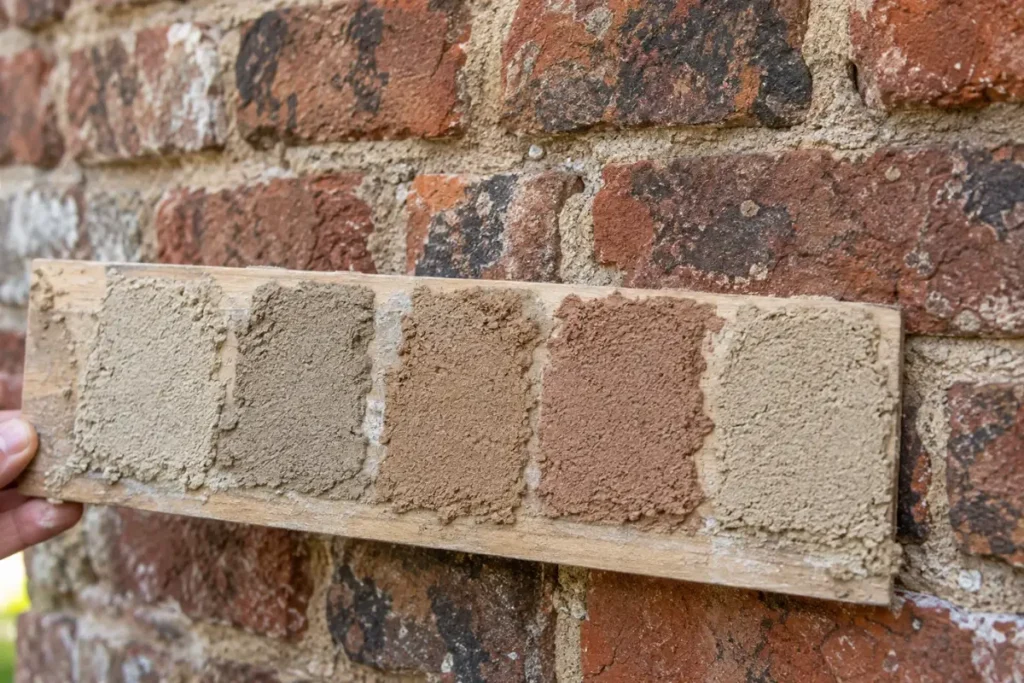
- Sand drives color and texture. Most of a mortar’s appearance comes from its sand, its color, grain size and shape, with the binder affecting the overall tone. Matching the sand is usually more important than adding pigment.
- Color changes as it cures. Wet mortar looks very different from cured mortar, so matches are judged on samples that have been allowed to cure. Preservation Brief 2 recommends test panels for this reason.
- Joint profile. The shape the joint is tooled to, whether flush, concave, struck or another profile, changes how the wall reads and how it sheds water. On older buildings, the original profile should be matched. Modern weather resistance preferences and historic matching can point in different directions, and on a historic building, matching usually wins.
- Joint width. Joints should stay the original width. Widening them during removal changes the look of the whole wall.
New mortar will usually look slightly fresher at first and blend further as it weathers. A good match is close on day one and closer in a year.
Signs Your Brick Was Repointed With the Wrong Mortar
You can often spot an incompatible repointing job from the ground:
- Spalled brick edges next to intact mortar. The brick is wearing away while the joints stand proud. This is the classic sign of mortar harder than the brick.
- Widened or ragged joints. Joints that are noticeably wider than the originals, or brick edges that are chipped and rounded, often point to aggressive removal, such as grinding, during earlier work.
- Mortar smeared over the brick face, sometimes called a buttered or feathered joint, which hides the brick edges and the true joint line.
- Obvious color or texture mismatch between patches of repointing and the original joints.
- Brick that started flaking soon after repointing.
What to do next. Don’t repoint over the problem with more of the same. The hard mortar usually needs to be carefully removed and the joints repointed with a compatible mix, and badly damaged bricks replaced. When the damage is spread across the building or combined with other past repairs, that’s the territory of masonry restoration. For a few damaged units, see masonry and brick repair.
Older Homes and Historic Districts in Hampton Roads
Several cities around Chesapeake have local historic districts where exterior work goes through review, and materials and appearance are part of what reviewers look at. Portsmouth uses a Certificate of Appropriateness process for districts including Olde Towne, Port Norfolk, Park View, Cradock and Truxtun. Norfolk’s Architectural Review Board covers districts such as Ghent and Freemason, with updated guidelines for applications from June 1, 2026. Hampton has historic areas such as Phoebus, where current review requirements should be confirmed with the city.
The preservation principle behind these reviews is the same one this guide is about: repair with materials compatible with the original. Even where no review applies, older brick benefits from the same approach.
Questions to Ask Before Repointing
Whoever does the work, these questions will tell you whether they’re thinking about compatibility:
- Which mortar will you use, and why? A good answer refers to the brick and the existing mortar, not just a product name.
- How will you remove the old mortar? Ask how they’ll avoid damaging brick edges or widening joints.
- How deep will the joints be cut? Preservation Brief 2 recommends removing mortar to a depth of about two to two and a half times the joint width, and deeper where it’s loose.
- Will you make a sample or test panel and let it cure before the full job?
- How will you match the color, texture and joint profile?
- How will the new mortar be protected while it cures?
If you’re planning repointing on an older home, our tuckpointing and repointing page covers the service, or call (757) 290-8274 for a free estimate.