
What Affects Chimney Repair Cost in Hampton Roads?
If you’ve searched for chimney repair prices, you’ve probably found ranges so wide they don’t help. That isn’t because contractors are vague. "Chimney repair" covers everything from sealing a hairline crack to taking a chimney down to the roof and relaying it, and the price of any particular job depends on what is actually wrong, where, and how hard it is to reach. This guide explains the factors that set the scope, so you can make sense of an estimate.
Why Chimney Repair Costs Vary So Widely
At one end is a small, targeted repair on an otherwise sound chimney: sealing fine cracks in a well built crown or repointing a few eroded joints. At the other is a partial or full rebuild of the stack above the roof, with a new crown and new flashing. Between them sit dozens of combinations.
That’s why national "average cost" figures online are a poor guide for a specific chimney. They mix together jobs of very different sizes, regions with different labor costs, and chimneys of different heights and materials. They also can’t account for what is found once work begins. A useful number only comes from looking at your chimney.
The Main Cost Factors
The type and extent of damage
What’s damaged matters more than anything else, and chimneys usually fail in more than one place at once.
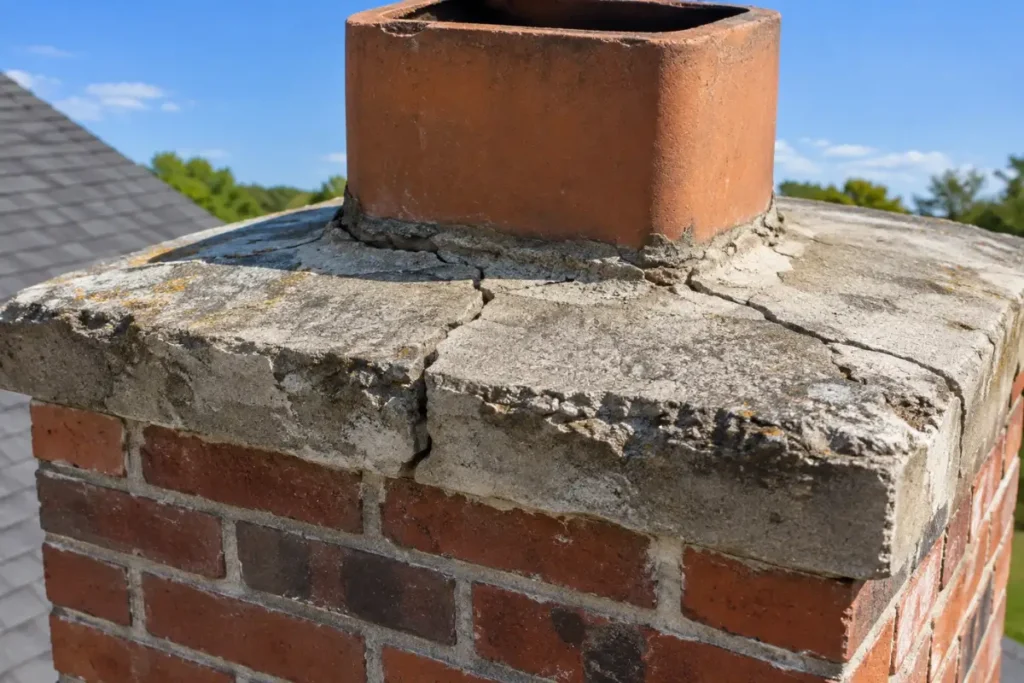
- The crown. A crown with fine surface cracks may only need sealing. One that is cracked through, crumbling, built as a thin layer of mortar, or missing its slope and drip edge needs rebuilding. The model residential code describes a properly built crown as durable, sloped to drain, with a drip edge and a bond break at the flue (2021 IRC Chapter 10, R1003.9.1), and bringing a crown up to that standard is more work than patching it.
- The mortar. A few eroded joints are a small job. Repointing an entire stack is larger, and the amount of joint that needs cutting out drives the labor.
- The brick. Replacing a handful of spalled bricks is different from replacing many across the stack.
- The flashing. Flashing has two layers, base or step flashing under the roofing and counterflashing set into the mortar joints, as the Brick Industry Association’s brief on flashing chimneys shows. Resetting counterflashing is a different job from replacing the whole system, which also involves the roofing around it.
Height, roof pitch and access
A short chimney on a low slope roof is far easier to work on than a tall one on a steep roof. Height and pitch decide how much safety equipment and setup the job needs, how much material has to be carried up, and how long each task takes. A chimney that can’t be safely reached from the roof may need scaffolding.
Partial or full rebuild
When damage runs through the top courses, the stack is taken down to sound masonry and relaid. How far down that goes is a major cost driver: a few courses below the crown is a very different job from rebuilding everything above the roof line. A full rebuild also brings a new crown and flashing with it. Rebuilds must meet the chimney provisions of Virginia’s current building codes, and a rebuild can require a permit.
Matching brick and mortar
Standard modern brick is easier to source than brick that has to match an older house. Older chimneys often need a softer, lime rich mortar matched to the original, which takes more care to mix and test than a standard bagged mortar.
Hidden water damage
Some damage can’t be seen until work begins. Water that has been getting in through a failed crown or flashing for years can loosen brick deeper in the stack, damage the area around the flue, or show up in framing and finishes at the roof line. A good estimate will say how unexpected findings are handled, so a surprise doesn’t become a dispute.
Exposure
In Hampton Roads, chimneys take wind driven rain from storms that the National Weather Service in Wakefield describes as bringing strong wind and heavy rain to the region. Chimneys on exposed or waterfront properties tend to wear faster, which can mean more damage by the time repair is needed. That’s a reason to check after major storms, not a fixed price premium.
Repair Now or Rebuild?
Targeted repair makes sense when the problem is limited and the rest of the chimney is sound: a crown that can be rebuilt on a solid stack, a few eroded joints, a flashing failure on otherwise good masonry. Fixing the specific problem is usually the most economical answer.
Rebuilding starts to make more sense when:
- bricks are loose throughout the top of the stack, not just in one spot
- the chimney leans or has visibly moved
- spalling and joint failure are widespread
- the top section has been patched repeatedly and keeps failing
In those cases, repairing one problem at a time tends to mean paying for repairs again and again. A rebuild of the damaged section, done once with a proper crown and flashing, can cost less over the life of the chimney. What an inspection finds inside and out is what tips the decision one way or the other.
Our chimney repair page explains crown repair, repointing and rebuilding in more detail.
How Inspections Affect the Estimate
An estimate is only as good as what the person writing it can see. Chimney inspections are described in three levels under NFPA 211, the national standard for chimneys: Level 1 covers readily accessible areas, Level 2 adds internal video scanning of the flue, and Level 3 reaches concealed areas when a hazard is suspected. A masonry estimate based on what’s visible outside can change if a later inspection finds damage inside the flue or the structure. If you’ve had a chimney inspection, share the report with anyone estimating the repair. The chimney repair page explains the levels more fully.
Getting an Accurate Estimate
Share what you can before the visit:
- Photos of the chimney from the ground on each side, and the top if it can be seen safely
- Photos of any stains, damp spots or water inside near the chimney or fireplace
- When you first noticed the problem and whether it gets worse after storms
- Any recent inspection report
- Whether the fireplace is in use, and what kind of appliance is connected
Questions to ask any contractor:
- What exactly is damaged, and what is causing it?
- Is this a repair or a rebuild, and how far down would a rebuild go?
- Will the crown be rebuilt with a slope, drip edge and bond break?
- Is the flashing being reset or replaced?
- How will brick and mortar be matched?
- Does the work need a permit, and who obtains it?
- How will hidden damage found during the work be handled and priced?
Virginia’s Department of Professional and Occupational Regulation recommends getting estimates and contracts in writing in its Consumer Guide to Choosing a Contractor, and you can check any contractor’s license through DPOR’s License Lookup.
CMC Chesapeake Masonry provides free chimney repair estimates across Chesapeake and the surrounding cities. Call (757) 290-8274 or send photos through our contact page.