
Retaining Wall Permits in Chesapeake, VA
Whether a retaining wall needs a permit in Chesapeake depends less on how tall it looks than on how much soil it holds back, what sits above it and where it is on your lot. This guide walks through the rules that usually decide the answer: Virginia’s building code, Chesapeake’s permit process, the Chesapeake Bay Preservation Area on waterfront lots, and the private checks that come before any digging. Rules and forms change, so treat it as a guide to the questions and confirm the details for your property with the City of Chesapeake.
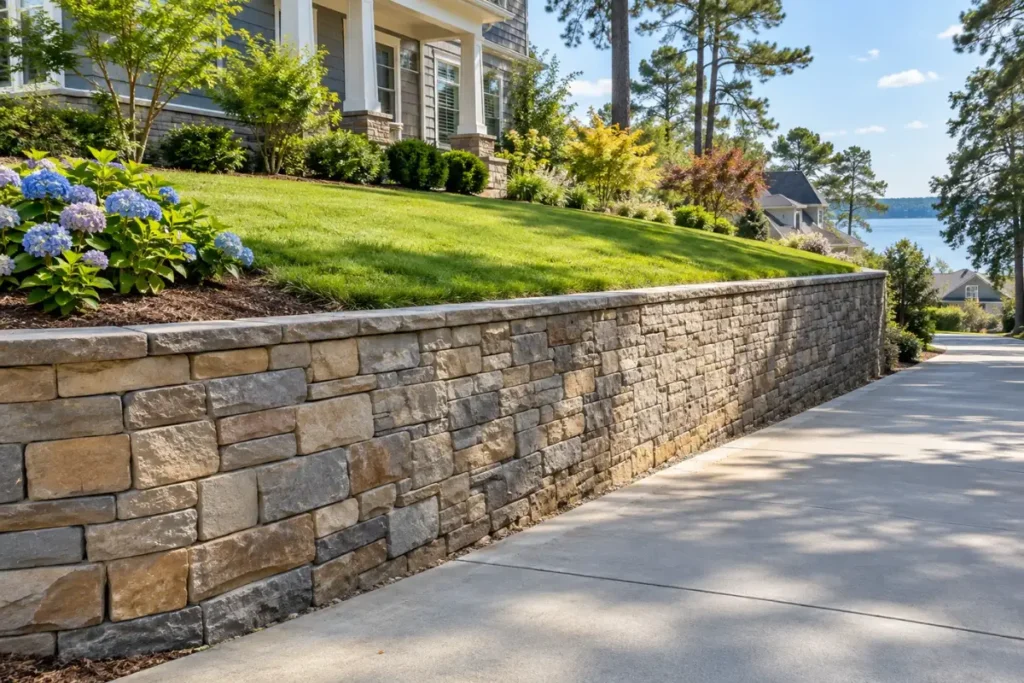
When a Retaining Wall Needs a Permit in Chesapeake
The three foot rule
Chesapeake enforces the Virginia Uniform Statewide Building Code. Under the 2021 Virginia Construction Code (§108.2), a retaining wall is exempt from a building permit when it supports less than three feet of unbalanced fill, as long as it isn’t supporting a surcharge or impounding liquids. Separate provisions remove some exemptions in special flood hazard areas, so a wall in a mapped flood zone may need a permit even when it’s short.
You may see a four foot figure in general articles about retaining walls. That comes from model code summaries, not from Virginia’s exemption, and it shouldn’t be relied on here.
How the height is measured
The test is unbalanced fill: the difference between the ground level on the high side of the wall and the ground level on the low side. It isn’t the total height of the blocks or stone, which includes any part below ground, and it isn’t simply how much wall you can see. A wall with four courses of block showing might retain less than three feet of soil, or more, depending on the grade on each side.
What changes the answer
- A surcharge. Anything that adds load above the wall, such as a driveway, parking area, structure, or a further slope rising behind it, takes the wall out of the simple exemption.
- Liquids. A wall that holds back water or other liquids isn’t covered.
- Flood zones. Special flood hazard areas have their own exceptions. The City’s Floodplain Management page explains how to check an address.
- Location. A wall in a Chesapeake Bay Preservation Area can need environmental approval even when no building permit is required (see below).
Where to confirm
Chesapeake’s Development and Permits department handles permits, plan review and inspections; its Building Permits, Plan Review & Inspections page is the starting point, and applications run through the city’s eBUILD system. For anything close to the threshold, carrying a load or near water, ask the city before building. CMC Chesapeake Masonry handles the permit for the walls we build when one is needed.
Our retaining walls page covers wall types, drainage and repair.
When Engineering Is Required
A permit and an engineered design are different questions. Even when a permit is needed, a simple wall may be approved on standard construction details. But the Virginia Construction Code (§109.3) allows the building official to require structural details and calculations, and that’s where engineered design comes in.
This guide hasn’t found a single published Chesapeake height above which every wall must be engineered, so there’s no number to quote. In practice, engineered design comes into play for taller walls, walls carrying a surcharge such as a driveway, walls on poor or wet soils, and segmental walls that rely on layers of soil reinforcement. The National Concrete Masonry Association’s guidance on segmental retaining walls treats those systems as designed structures, where the unit, the reinforcement, the drainage and the base all work together.
An engineered design typically sets the wall’s height and geometry, the footing or base, any reinforcement and its spacing, the drainage behind and below the wall, and the soil assumptions behind those choices. CMC Chesapeake Masonry does not provide engineering services; when a wall needs an engineered design, it is built to that design.
Waterfront Lots and Chesapeake Bay Preservation Areas
Parts of Chesapeake lie near rivers, creeks and wetlands. Under Virginia’s Chesapeake Bay Preservation Act, land near those waters can fall within a Chesapeake Bay Preservation Area, and the most protected part is the Resource Protection Area (RPA). State regulations (9VAC25-830-80) define the RPA’s protected features and require a buffer of at least 100 feet landward of them.
What that means for a retaining wall:
- Check the map first. The City’s Chesapeake Bay Preservation Area page has an interactive map for an initial screen, plus links to the local ordinance and exception applications. A site specific delineation can refine the mapped boundary.
- Think beyond the wall itself. Building a wall involves clearing, grading, access for equipment and material storage, and each of those can be a land disturbance inside a buffer.
- Expect a review, not an automatic no. Work in an RPA buffer is limited, but the city has administrative and exception routes for some projects. The City’s CBPA specifications manual, amended November 5, 2025, sets out how RPAs are delineated and what applications need.
Landscape walls vs. shoreline walls. A retaining wall in the yard that holds back soil is a different kind of project from a structure at the water’s edge built to hold back water or protect a shoreline. Shoreline structures involve their own reviews and are outside the scope of this guide.
Property Lines, Easements and HOAs
A permit tells you the city’s building and environmental requirements are met. It doesn’t settle these private and zoning questions, so check them before you dig.
- Setbacks. Chesapeake’s residential zoning districts each have their own development standards. Building setbacks don’t automatically tell you where a wall can go, so confirm wall placement with the city for your zoning district.
- Easements. Your survey, deed and plat show recorded easements, such as drainage or utility easements, where a wall may not be allowed or could have to be removed later.
- Utilities. Contact Virginia 811 before digging. Its guide to private utilities explains that a locate ticket marks public lines but not privately owned ones, such as lines running to a detached garage or landscape lighting, so those need locating separately.
- HOA rules. If your property is in a homeowners association, its covenants may require approval for walls, materials or colors, and city approval doesn’t override them. Virginia DPOR’s Common Interest Community Ombudsman has resources on association governing documents and owners’ rights.
The Permit Process, Step by Step
Chesapeake publishes a residential process for additions and alterations that a permitted retaining wall generally follows. In outline:
- Prepare the application. A plan of the wall and its location, usually on a property survey, with drainage shown. Where the building official requires them, structural details or an engineered design.
- Zoning review. The city checks the wall’s location against zoning requirements.
- Plan review. The construction details are reviewed against the building code.
- Permit issuance through eBUILD.
- Inspections. Required inspections, such as the footing or base, happen before work is covered up.
The city’s Residential Addition / Alterations page describes the steps and the survey and drainage requirements. Published review times are estimates, not guarantees, so build them into the schedule. If a Bay Preservation Area review applies, it runs alongside or ahead of this process.
When CMC Chesapeake Masonry builds a wall that needs a permit, we handle the application. To talk through a project, call (757) 290-8274 or request a free estimate.
If Your Property Is Outside Chesapeake
The Virginia building code applies statewide, but each city runs its own permit office, its own zoning rules and its own environmental reviews, and local guidance can differ. Virginia Beach, for example, requires a zoning permit for walls within 30 feet of a public right of way, and Norfolk’s own FAQ has listed a different wall figure from the state exemption. Check with the right office:
| City | Where to start | Our city page |
|---|---|---|
| Portsmouth | Department of Permits and Inspections | View page |
| Virginia Beach | Planning and Community Development (residential building permits) | View page |
| Norfolk | Planning and Building Safety | View page |
| Suffolk | Community Development | View page |
| Hampton | Development Services Center | View page |
| Newport News | City residential building permit office (Residential Building Permit Checklist) | View page |
See all our service areas.